

Yapping About Indochinese Architecture
not an architect, just an obsessed writer researching

I first visited Paris in December 2016. Shortly after Christmas, the city of love welcomed me with blistering cold wind and dreamy streets. We stopped at every corner to take a picture, and when I sent them to my dad, he hit me with “Are you sure it’s not just Bốt Hàng Đậu?”
France left its mark in Vietnam more than just in history, but in art and especially architecture. Most of our most famous painters at that time went to Paris to study fine arts. The wave of Vietnamese romantic literature was born, but authors in the 1920s wrote little about lovers and more often about Hanoi. Thạch Lam dedicated a whole book on Hanoian streets and a whole chapter on the culinary arts. Arriving in Paris was, pretty much, seeing my city on a big scale. Eight years later, I wrote this:
“Must not have been as beautiful as Paris.”
Once again she was met with silence. [He] didn’t even look at her. He was frozen in his seat, lips pressing down on his tongue like he was licking his bottom lip when time stopped. If he had not been so annoying, [she] would have found it easier to admit how his melancholy left a sour aftertaste in her mouth.
Finally, she was compelled to ask. “What did you see in Paris?”
In her eyes, the dim glow of the street lantern danced to the steady beat of his heart.
“Hà-Nội.”
Indochine Style is a style in which French architecture is dominant to architectural works in Indochina countries during the French colonial period. It is considered the intersection between Asian and European cultures. A French kiss from an East Asian woman.*
Indochinese architecture in Vietnam has the ancient and attractive features of French architecture, combined harmoniously with the cultural and traditional beauty of Vietnamese history. The intersection between the two cultures existing in Indochine architecture helps create a unique landscape, full of nostalgia, rusticity, luxury and modernity.
I visited Saigon at the cusp of monsoon season, when the rain was late but the heat had already fled. Upon an hour of arriving, the cab driver revealed to me one unique feature of Saigon — there is one straight road leading directly from Tân Sơn Nhất Airport to the Independence Palace. This was because during the French colonial time, Saigon was the centre of diplomacy, so the architect had cheekily built it with a single purpose.
Saigon 1920s


In the late 19th and early 20th centuries, when they first arrived in Indochina, the French introduced the entire Neoclassical style that was popular in Europe at that time into construction in Vietnam. The Indochina Governor-General’s Palace (now the Presidential Palace) or the Hanoi Cathedral are some of the typical works.
However, during the construction process, French architects realised many shortcomings when copying famous works in their homeland. The hot and humid tropical climate, the monsoon of Indochina, along with the materials and craftsmanship of Vietnamese workers, were completely different from the developed construction techniques and temperate climate in Europe, with most of the works built of stone.
Saigon in 2024


To solve this difficult problem, a new architectural style was born. As Chief Architect and Director of the Department of Planning and Architecture of Indochina, Ernest Hébrard is considered the founder of a completely new architectural style, especially favoured by the local elite.
Indochina architecture also utilises different insulation and ventilation solutions to ensure the best fit with the tropical climate conditions in Vietnam. Unlike France, southern Vietnam has two seasons — dry and monsoon. Or as locals say, hot and very hot. So, the design often adds more corridors and wide pergolas running along the building. The wall near the roof is built with additional louvres to bring light to the interior space.
Hanoi in 1920s


The Eastern feature in Indochine architecture is the tiled roofs. The roof design often extends far to block sunlight and rain from entering the interior. Some architectural works use high-pitched or overlapping roofs on top of the traditional classical architectural style, with decorative patterns at the top or at the concave points.


The colours commonly used in Indochinese design are yellow, white, and beige. These tones, when covered with colour over time, will exude a very distinctive classic look.
To end this long post, I want to highlight my favourite building — the Hanoi Opera House (though my character HATES it). Growing up around the area, I passed by it almost every day going to school, but never went inside until I had spent a whole year away from Hanoi.
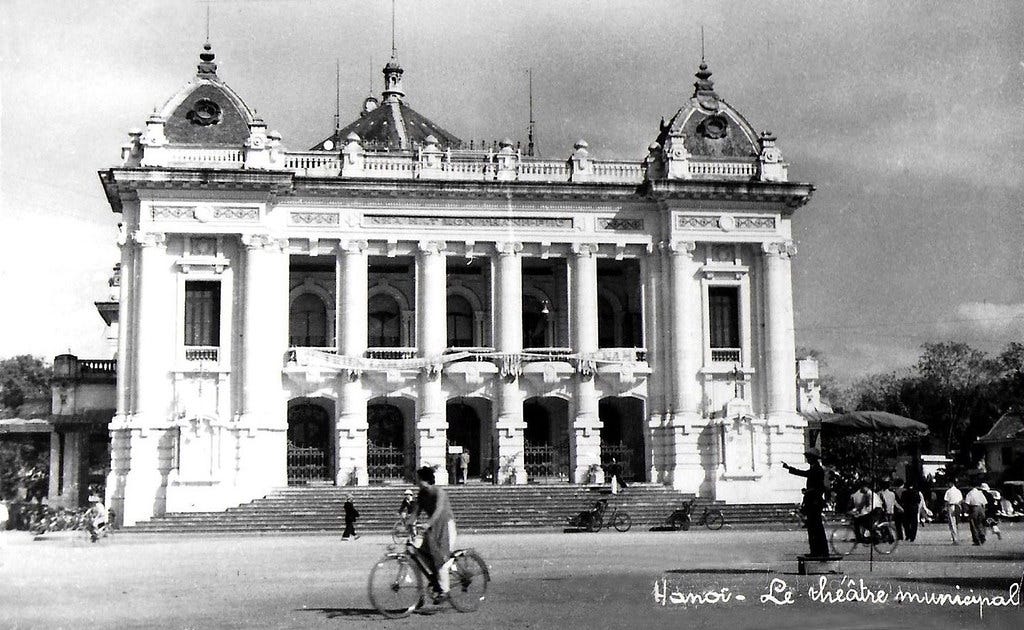
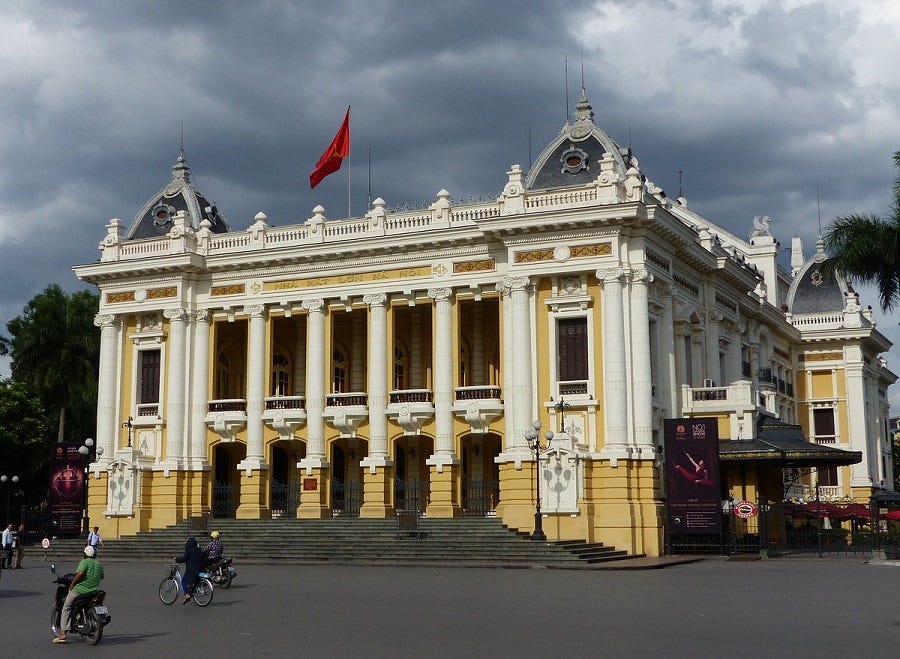
One day, all of this will make it into a book in your hands. My alternative historical fantasy book features my love for Hanoi, and I hope you’ll see the landscape and this very unique architectural style.
** The actual term used was Á Đông, which is translated to “East Asian.” Although Vietnam is a Southeast Asian country, our culture is a mix of Sinosphere and old Champa cultures. In most Vietnamese-language texts, you will find that the country was referred to as “East Asian” without the specificity of the region. The word “nam” means “south.”
SOO INTERESTING